Selecting the wrong butterfly valve body style can lead to installation headaches, leakage at the flange joint, or costly rework during plant shutdowns. This guide breaks down the structural differences, installation requirements, pressure limitations, and cost trade-offs between the three dominant butterfly valve body types — wafer, lug, and double flange — so you can specify the right valve for every piping application.
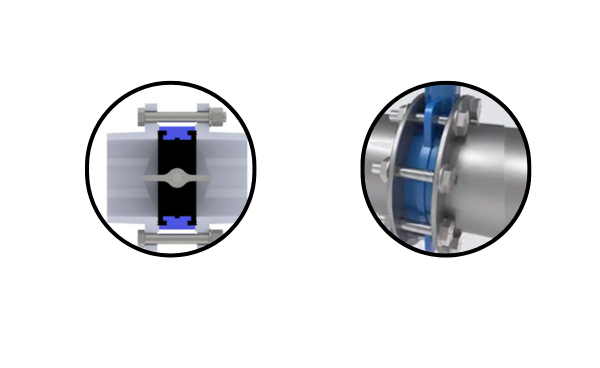

Clamped between two pipe flanges with long through-bolts or stud bolts. No lug ears or flange holes on the valve body itself. The simplest, lightest, and most economical design.
Best for: General isolation service, non-end-of-line, low-to-medium pressure


Threaded inserts (lugs) cast into the valve body. Bolts thread into the lugs from each pipe flange side. Allows downstream pipe removal without upstream shutdown.
Best for: Dead-end / end-of-line service, frequent maintenance sections


Integral flanges on both sides of the valve body, bolted flange-to-flange with the mating pipe flanges. Self-centering, maximum joint rigidity, full-rated pressure in both directions.
Best for: High-pressure, large-diameter, critical isolation, buried service
The wafer butterfly valve has no mounting lugs and no integral flanges. The body is a thin ring — typically ductile iron, carbon steel, or stainless steel — that fits between two standard pipe flanges (e.g., PN10/PN16, Class 150). Long stud bolts pass through both pipe flanges and clamp the valve body in place. The valve relies on the surrounding pipe flanges and gaskets for alignment and seal compression.
| Parameter | Wafer Butterfly Valve |
|---|---|
| Face-to-Face | Shortest of the three types — per EN 558 Series 20 / API 609 Category A |
| Weight | Lightest; minimal body material |
| End-of-Line Capable? | No — requires flanges on both sides for clamping |
| Bolt Set | Long through-bolts or continuous stud bolts spanning both flanges |
| Centering | Relies on pipe flange bolts for alignment; no self-centering flange pilot |
| Typical Sizes | DN40 to DN1200 (larger sizes usually switch to double flange) |
| Pressure Rating | PN6, PN10, PN16, Class 150 |
The lug butterfly valve body has threaded metal inserts (lugs) cast or machined into the body at each bolt-hole position. Bolts from the pipe flange thread directly into these lugs. Each side of the valve has its own independent bolt set — the upstream bolts do not pass through to the downstream side. This split bolting arrangement is the defining feature that enables dead-end service.
| Parameter | Lug Butterfly Valve |
|---|---|
| Face-to-Face | Same as wafer — EN 558 Series 20 / API 609 Category A (short pattern) |
| Weight | Heavier than wafer due to lug ears |
| End-of-Line Capable? | Yes — rated for dead-end service at full working pressure with downstream blind flange |
| Bolt Set | Two independent bolt sets; bolts do not pass through the valve body |
| Centering | Lugs assist, but still relies on bolt circle alignment |
| Typical Sizes | DN50 to DN600 (above DN600, double flange is preferred) |
| Pressure Rating | PN10, PN16, Class 150 (dead-end rating must be confirmed by manufacturer) |
The double flange butterfly valve has integral raised-face (RF) or flat-face (FF) flanges on both ends of the body — exactly like a flanged gate or globe valve. It bolts directly between two matching pipe flanges using standard-length stud bolts, with a gasket on each side. The valve is fully self-centering and provides the most rigid, leak-tight joint of the three types.
| Item | Double Flange Butterfly Valve |
|---|---|
| Face-to-Face | Longest — per EN 558 Series 13 / API 609 Category B (long pattern); typically 1.5x to 2x wafer/lug |
| Weight | Heaviest; full flanged body casting adds significant mass |
| End-of-Line Capable? | Yes — full rated pressure, both sides |
| Bolt Set | Standard-length stud bolts; each flange joint independent |
| Centering | Self-centering via flange pilot / raised face; no alignment required beyond bolt-up |
| Typical Sizes | DN200 to DN3000+ (the only practical choice above DN1200) |
| Pressure Rating | PN10, PN16, PN25, PN40, Class 150, Class 300 |
| Criterion | Wafer | Lug | Double Flange |
|---|---|---|---|
| Face-to-Face Length | Short (EN 558-20) | Short (EN 558-20) | Long (EN 558-13) |
| Body Weight | Lightest | Medium | Heaviest |
| End-of-Line / Dead-End | No | Yes (verify rating) | Yes (full rating) |
| Bolt Pattern | Through-bolts span both flanges | Independent bolts per side | Independent bolts per side |
| Self-Centering | No — bolt circle only | No — bolt circle only | Yes — flange pilot |
| Maximum Size (typical) | DN1200 | DN600 | DN3000+ |
| Maximum Pressure (typical) | PN16 / Class 150 | PN16 / Class 150 | PN40 / Class 300 |
| Relative Cost (same size/material) | 1.0 (baseline) | 1.3 – 1.5× | 1.8 – 2.5× |
| Valve Removal for Maintenance | Entire bolt set must be removed; pipe flanges must spread | Unbolt each side independently; pipe must spread | Unbolt each side independently; pipe must spread |
| Gasket Required | Optional flange gaskets or integral liner face | Optional flange gaskets or integral liner face | Two flange gaskets required |
| Buried Service Suitable | No | Not recommended | Yes (with corrosion protection) |
| Vacuum Service | Yes (within rating) | Yes (within rating) | Yes (preferred for full vacuum) |
Use this sequential logic to narrow down the correct body style:
The cost hierarchy is consistent across manufacturers: wafer < lug < double flange. However, valve body cost is only one component of total installed cost. Consider these hidden factors:
| Cost Factor | Wafer | Lug | Double Flange |
|---|---|---|---|
| Valve purchase cost | Lowest | +30–50% | +80–150% |
| Bolt set cost | Long through-bolts (higher) | Two sets of short bolts | Two sets of standard bolts |
| Gasket cost | 0–2 gaskets | 0–2 gaskets | 2 gaskets required |
| Installation labor | More alignment effort; single bolt-up | Moderate; two independent bolt-ups | Easiest — self-aligning; two bolt-ups |
| Pipe support requirements | Minimal (lightest) | Moderate | Additional supports may be needed |
| Maintenance downtime cost | Highest — entire spool must be spread | Lower — independent side removal | Lower — independent side removal |

Yes, provided the face-to-face dimensions match. Both wafer and lug valves typically conform to the same short-pattern standard (EN 558 Series 20 / API 609 Category A), so they are dimensionally interchangeable for the same size and pressure class. You will need different bolts: lug valves use two independent bolt sets instead of through-bolts.
The valve has no structural retention against the upstream pressure. When the valve is closed under pressure, the force acting on the disc is transferred to the body, which has nothing restraining it. The valve can eject violently from the pipe end. This is why wafer valves must always be clamped between two flanges.
Lug valves rely on threaded inserts cast into the body. Above DN600, the bolt loads and bending moments on individual lugs become difficult to manage in a compact body. A double flange design distributes bolt loads across a full-circumference flange, which scales more efficiently to large diameters. Additionally, large-diameter butterfly valves are often heavy-wall castings that benefit from the structural rigidity of an integral flange.
It depends on the valve design. Rubber-lined or PTFE-lined butterfly valves typically have the liner material extending onto the face of the body, forming an integral gasket surface. In these cases, additional flange gaskets are not required and may actually cause sealing problems by creating a double-gasket situation. For metal-seated or high-performance butterfly valves with a bare metal face, flange gaskets are required. Always follow the manufacturer's installation instructions.
All three body styles can be automated with pneumatic or electric actuators via an ISO 5211 top mounting flange. The choice between wafer, lug, and double flange is driven by the piping requirements, not the actuator interface. However, for large automated valves (DN300+) in modulating service, double flange is often preferred because the stiffer body resists deflection under the cyclical torque loads from continuous positioning.
Dead-end ratings are typically developed for positive internal pressure. Under vacuum, the load direction reverses (external atmospheric pressure pushes inward on the disc). Confirm with the manufacturer that the lug valve's dead-end rating covers vacuum conditions. If in doubt, specify double flange for vacuum dead-end service — the bolted flange joint is inherently bidirectional.
All technical data provided for general engineering reference. Consult specific manufacturer datasheets and your project's piping specification for final valve selection. For assistance selecting the correct butterfly valve body style for your application, contact Laux Valve engineering support.


